
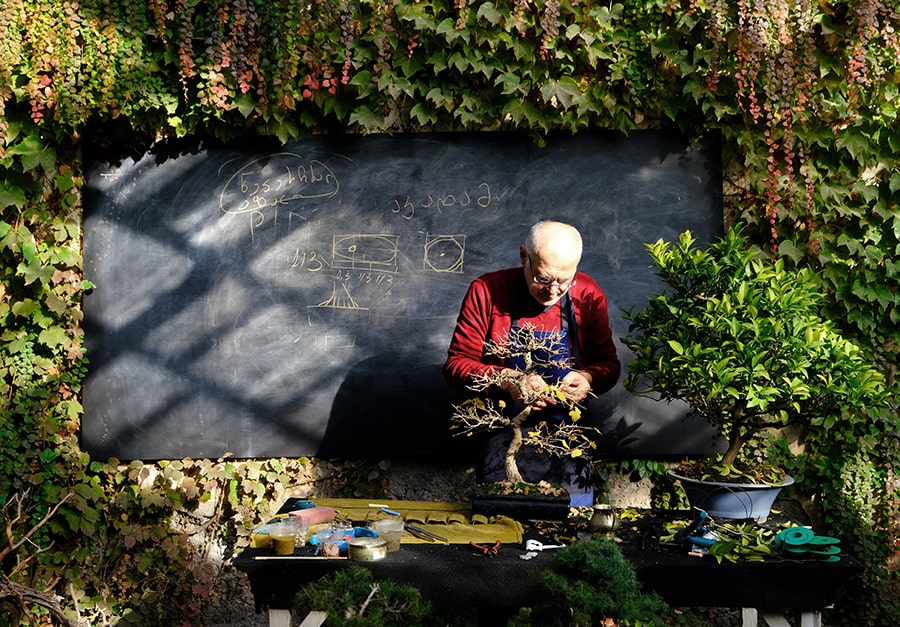
A well-developed and healthy bonsai depends on a properly chosen soil mix. The soil should contain enough nutrients, allow for good water drainage (water should not pool on the surface during watering), retain moisture, and provide the roots with adequate oxygen.
One of the most debated topics among bonsai enthusiasts and specialists is preparing the soil mix for bonsai. Each specialist has their own recipe for creating the soil mix, based on personal experience and considering climate conditions. Therefore, you will not find two identical recipes for bonsai soil in books or online sources.
There are granules specially prepared for bonsai, such as akadama, an inorganic soil. As far as I know, akadama is not sold in Georgia and can only be purchased online. These granules make repotting easier, but they are quite expensive. Enthusiasts abroad also note this. Some specialists believe that akadama is not ideal for bonsai, as it breaks down into dust after a certain period (about 2 years). There are also soil mixes made from pumice, various types of peat, pine bark, fired clay granules, volcanic granules (lava), etc. I have never used akadama or pre-made mixes, so it's difficult for me to speak about their positive or negative aspects. I always prepare the soil mix myself. (Probably like all bonsai enthusiasts living in Georgia.)
When I started working with bonsai, I would collect soil from the forest or somewhere outside the city. I would heat it on a metal wide container over a fire to eliminate pests and diseases. Then I would sift it through two different-sized sieves and add sand to the mixture.
Currently, I mainly use substrates made from peat, which are imported by almost all garden stores from abroad. This substrate is sterile and is packaged in bags for various types of plants.
For each plant, a substrate suitable for its acidity (pH) should be chosen. Usually, the pH of the substrate is always indicated on the packaging.
Strongly acidic (pH = 3-4);
Acidic (pH = 4-5);
Weakly acidic (pH = 5-6);
Neutral (pH = 7);
Weakly alkaline (pH = 7-8);
Alkaline (pH = 9-11);
For conifers and maples, I use an acidic substrate, while for other trees, I use neutral or slightly alkaline. I add yellow fine sand (so-called "Satchkheri sand") to the substrate, in a 1:1 ratio (one part substrate, one part sand). First, I sift the sand to remove debris and large stones. Then, I wash it thoroughly with running water to remove dust. After washing, I dry it and then add it to the substrate. Fine sand prevents soil from clumping, promotes the growth of fine roots, and retains moisture.
Another component is coarse sand (concrete sand) to improve soil water permeability and root aeration. To sift this sand, I use two different-sized sieves: a fine one (with about 4 holes per centimeter) and a coarse one (with 2 holes per centimeter). First, I sift it through the coarse sieve. The remaining large fraction is discarded. Then, I sift it through the fine sieve. The very fine fraction should be thrown away. The remaining fine sand is used for the soil mix. This sand also needs to be thoroughly washed.
I mix the substrate and fine sand in a 1:1 ratio. To this mixture, I add coarse sand in a 1:3 ratio—1 part coarse sand, 3 parts substrate and fine sand mix. I thoroughly mix the ingredients together to achieve a uniform mass. Instead of coarse sand, pumice can be used.
Preparing a soil mix for bonsai is a labor-intensive task that requires a significant amount of time, especially when repotting many bonsai plants.