How to start styling a young plant (part IV)

Styling with wire
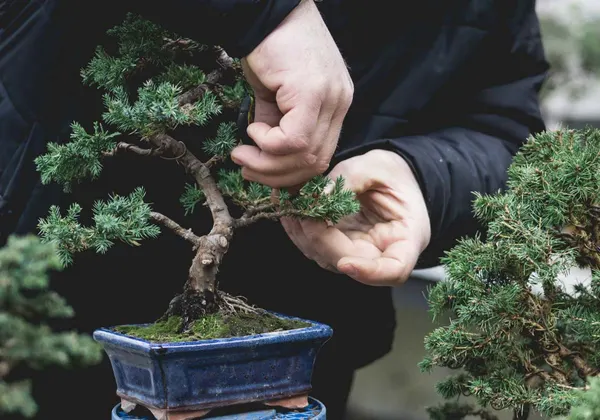
Once you have finished the first pruning, we should begin changing the direction of growth of the branches and trunk with wire. Some species respond easily to wiring — conifers, for example. Others have such hard wood that wiring is only possible on newly grown branches. On some trees the bark is damaged quite easily by wiring. With all this in mind, so as not to harm your tree, it is best for beginners to practice wiring first on plants growing in nature, to train their hands. If you use copper wire for styling, it is best to heat it over a flame until it glows red and then let it cool in the air (not in water), so that it becomes easier to work with and more pliable in the hand. Aluminum wire melts when heated, so it must never be heated. First you need to choose the right wire thickness and length. The thickness should match the thickness of the branch: if you use thick wire on a thin branch, there is a good chance of breaking it, while thin wire won’t hold a thick branch in the position you want. To start with, let’s say the wire should be about 1/3 the thickness of the branch. You should also work out in advance what length of wire you will need. Wire that is too long will get in your way, while wire that is too short will of course not be enough, and you will have to remove it and wrap on a new piece of the right length. Here too, let’s say the wire should be about 1/3 longer than the branch you intend to style.
Applying the wire
The trunk is styled first. If a young plant already has a trunk a few centimeters thick, in most cases it is impossible to set it in the desired shape with wire. That is why the trunk can be shaped with wire only at an early stage of the tree’s growth. A special clamp is used to shape thick trunks and branches.
 I would recommend such a clamp only to experienced bonsai enthusiasts. A beginner would do better to avoid using this kind of tool and to work with the shape the trunk already has.
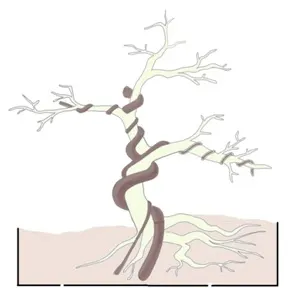
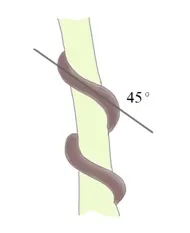
When we begin shaping the trunk, the wire must first be firmly anchored at its starting point: we push one end of the wire as deep as possible into the soil, close to the trunk. Then, slowly, we bend the trunk in the desired direction while wrapping the wire around it in a spiral. We should try to keep the spacing between the coils even. It is no good when the coils are too close together, as this can damage the tree. If the coils are spaced too far apart, it may not be possible to hold the position. The spacing between the coils depends on the trunk’s thickness and flexibility. Ideally the coils should run at an angle of 45 degrees to the trunk; wire wrapped this way is more effective and holds the tree in the desired position more easily. Of course, in many cases it isn’t possible to wire this “perfectly”, and there will always be something in the way. But the main thing is not to wire “perfectly”; it is to hold the tree in the desired position.
 When wiring a trunk, you need to choose the right places to bend it. First of all, the outside of a bend should not be on the front, viewing side; in other words, it should not point toward the viewer. It is also best to make the bends where the main, thick branches are positioned.
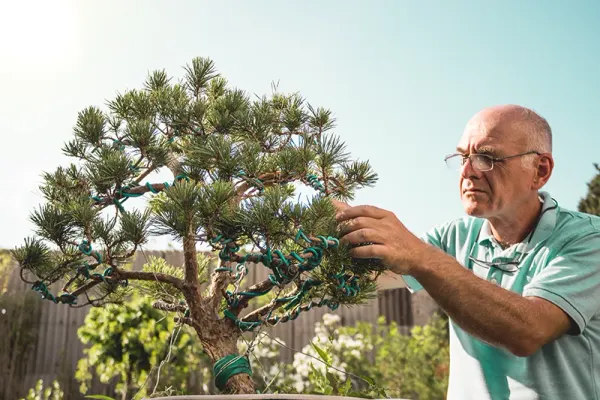
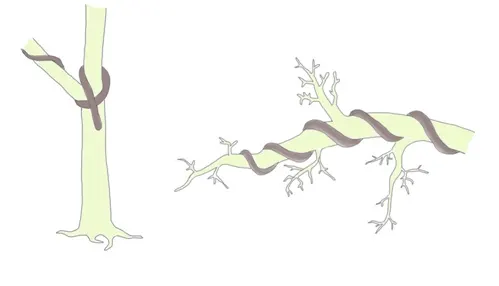
When styling branches, one end of the wire is anchored on the trunk, at the fork. First we make one coil around the trunk and secure it well, so that when we wrap the wire along the branch, the coil on the trunk doesn’t loosen or shift. Then we slowly bend the branch in the desired direction and wrap the wire in a spiral from the base of the branch to its tip.
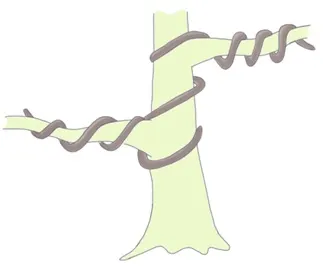
We take one long piece of wire, fold it in two and wrap the fold around the trunk. One half of the wire is wrapped around one branch, and the other half around the other branch. In this case it is best for both branches to be roughly the same thickness. Pay attention to the secondary branches and the buds. When styling a branch, the wire must not damage either the buds or the fine twigs. Great care is needed when putting on the wire framework. A single wrong move can break a branch. If you hear a suspicious cracking sound or realize that something isn’t going the way you planned, stop at once. If you decide to bend a branch in several places, try to make the bends where the secondary branches are, because in nature these are exactly the points where a branch changes direction. A secondary branch should grow from the outside of the bend, not the inside. If you don’t have wire of the right thickness, you can double up the wire and wrap it on the tree that way The wire stays on for 1–6 months. How long depends on the species and on the size of the branch and trunk. Conifers take longer to set in shape than deciduous trees. After wiring, be sure to keep an eye on the tree. As branches and the trunk grow in length, they also thicken. Because of this, the wire gradually begins to bite into the bark. If you notice this happening, be sure to remove the wire. If the wire is removed too late, quite ugly grooves appear where it was wrapped. Such damage takes a long time to heal, and the scars may remain on the branch for good.
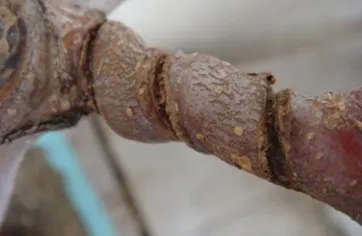
If you notice that wiring damages the tree’s bark, first wrap the branch or trunk along its whole length in thick cloth or rubber. There is a special material, “raffia” (palm fiber), which is moistened and wrapped tightly around the branch or trunk before the wire is wound over it.
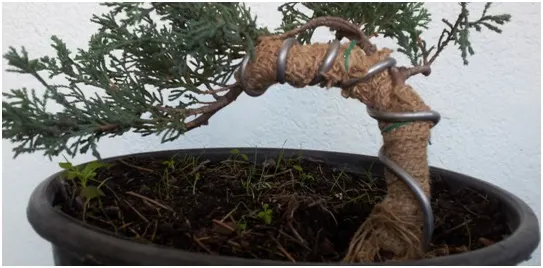 Once the branch or trunk has set in the desired shape, the wire should be removed. This is best done with wire cutters. Cut the wire in several places; that way you can remove it easily. If you try to save the wire as you remove it, you may damage small branches and shoots. If the wire had to come off to avoid damaging the tree and the branch or trunk has not set in the desired position, rewire it only after one season.
When to wire
Wiring can in fact be done at any time of year. But every period has its advantages and disadvantages. On broadleaf trees the best time is when the tree is bare, preferably at the end of winter. At that time there are no leaves to get in your way, the branches are more flexible and the overall shape of the bonsai is easier to see. When a tree is in full leaf, it is hard to study the whole structure of the bonsai, and wrapping wire around a branch while avoiding the leaves is much more difficult. But there are times when the shape of a branch has to be corrected during the growing season. In that case the wiring must be done very carefully, without damaging the leaves. In spring, branches grow quickly in length and thickness, and there is a greater risk of the wire biting into the bark and damaging it. So after wiring in spring, closer attention is needed. On conifers it is best to wire in autumn, before the frosts begin.
Other methods of shaping the trunk and branches
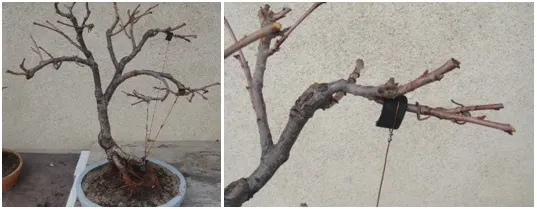
There are often cases where the direction of growth of a trunk or branch can be changed more simply than by building a wire framework. For example, a trunk can be shaped by tying it to an iron or wooden stake. Or a wire can be anchored to the pot and the tree pulled in the desired direction.
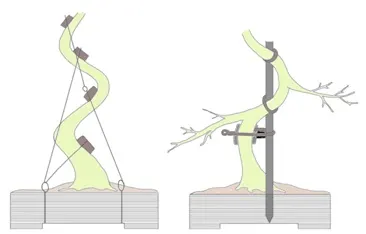
As for branches: if we want to bring a branch down, we can pull it with a wire or string anchored to the pot or to a root. Changing a branch’s direction of growth this way requires the use of force. So to avoid damaging the branch, first put some soft padding (a piece of rubber, for example) where the wire will be attached, and then fix the wire over it.