Soil for bonsai
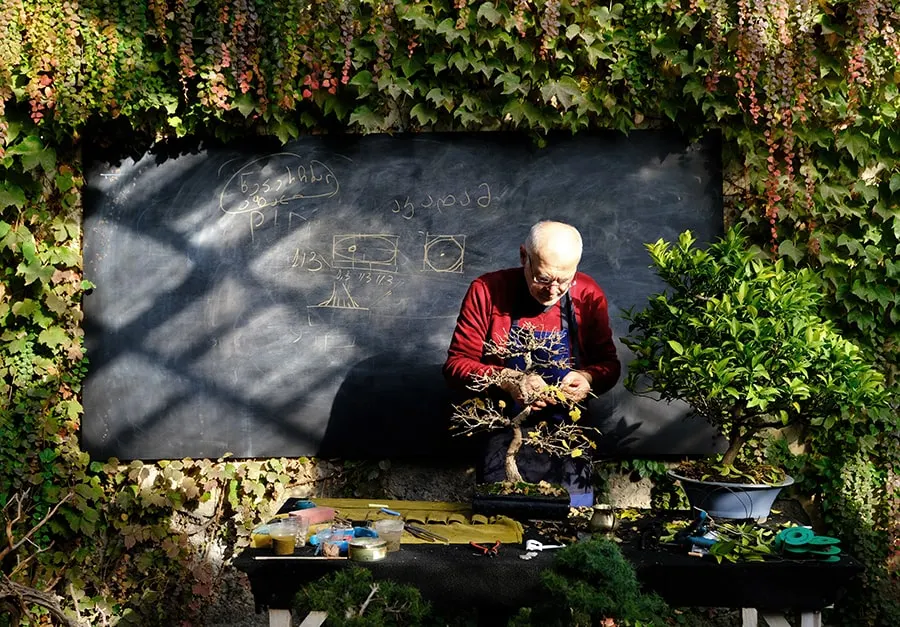
One of the key conditions for growing a well-developed, healthy bonsai is the right soil mix. The soil must contain enough nutrients, drain water well (water should not pool on the surface when you water), retain moisture, and keep the roots supplied with oxygen.
One of the most debated questions among bonsai enthusiasts and professionals is how to prepare a bonsai soil mix. Every specialist has their own recipe for making a soil mix, based on their own experience and suited to their climate. That’s why you won’t find two identical bonsai soil recipes in books on bonsai or on websites.
There are granules made specially for bonsai — akadama, the so-called inorganic soil. As far as I know, akadama isn’t sold anywhere in Georgia; you can only order it online. These granules make repotting a good deal easier, but they are quite expensive. Enthusiasts living abroad say so too. Besides the cost, some specialists believe akadama is not ideal for bonsai. Reportedly, after a certain time (2 years) akadama breaks down and practically turns to dust. There are also soil mixes made from ingredients such as pumice, various kinds of peat, pine bark, fired clay granules, granules of volcanic origin (lava rock) and so on. I have never used akadama or ready-made mixes, so it’s hard for me to talk about their pros and cons. I always make my soil mix myself. (As, probably, does every bonsai enthusiast living in Georgia.)
When I started working with bonsai, I used to collect soil in the forest or somewhere out of town. I would heat it over a fire in a wide metal pan to get rid of any pests and diseases in it. Then I would sift it through two sieves of different sizes and add sand.
These days I mainly use peat-based substrates, which almost every garden center imports from abroad. This substrate is sterile and comes packed in bags for different kinds of plants.
Each plant needs a substrate with a suitable acidity (pH). As a rule, the substrate’s acidity is always printed on the bag.
Strongly acidic (pH = 3-4);
Acidic (pH = 4-5);
Slightly acidic (pH = 5-6);
Neutral (pH = 7);
Slightly alkaline (pH = 7-8);
Alkaline (pH = 9-11).
For conifers and maples I use an acidic substrate; for other trees, a neutral or slightly alkaline one. I add fine yellow sand (the so-called Sachkhere sand) to the substrate, in a 1:1 ratio (one part substrate, one part sand). First I sift the sand to remove any debris and larger stones. Then I wash it thoroughly under running water to remove the dust. After washing, I dry it and only then add it to the substrate. Fine sand keeps the soil from caking, encourages the growth of fine roots and retains moisture.
One more component is coarse sand (builder’s sand), to improve drainage and root aeration. To sift this sand I use 2 sieves of different sizes: one with a fine mesh (about 4 holes per centimeter) and one with a coarse mesh (2 holes per centimeter). First I sift it through the coarse sieve. What stays in the sieve is the large fraction and gets thrown away. Then I sift it through the fine sieve. The very fine fraction that passes through should be discarded. What stays on the fine sieve is what I use for the soil mix. This sand must also be washed thoroughly.
First I mix the substrate and fine sand together 1:1. To this mix I add coarse sand at 1:3 — 1 part coarse sand to 3 parts of the substrate-and-fine-sand mix. I mix the ingredients together thoroughly so that the result is uniform. Pumice can be used instead of coarse sand.
Preparing soil mix is quite labor-intensive and takes a lot of time, especially if you have many bonsai to repot.