Tools and supplies for bonsai
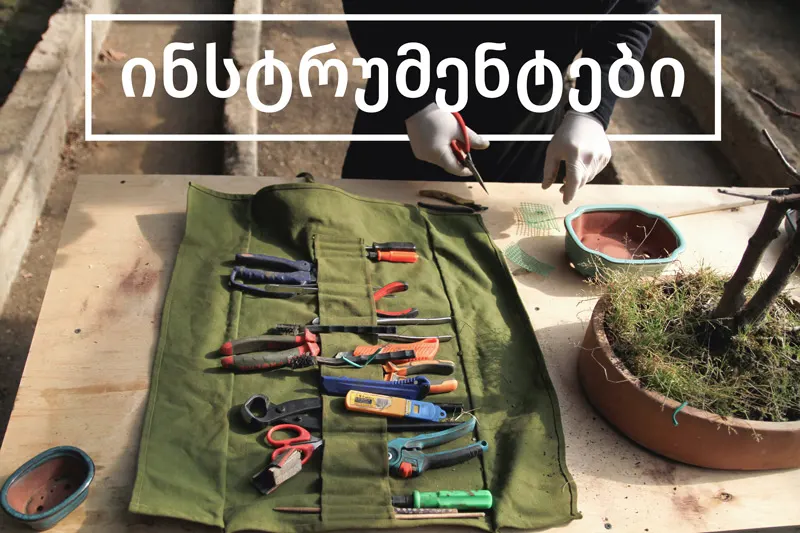
To carry out the rather specialized work involved in growing bonsai, you need certain kinds of tools. All over the world, enthusiasts and professionals alike prefer tools designed specifically for bonsai. These tools are not very different from ordinary gardening tools, but they are more convenient for working on miniature trees and make styling and repotting noticeably easier. They can only be bought in specialist bonsai shops.
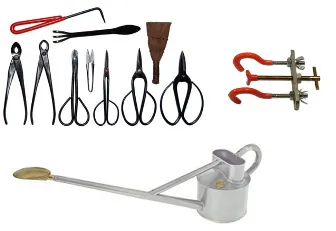
If you can’t get hold of these tools, ordinary garden tools will do perfectly well. Most people know them well, and they are easy to buy.
-
Pruning shears (secateurs), for cutting thick branches and roots.
-
Scissors for cutting fine branches and shoots.
-
A small pruning saw for cutting very thick branches.
-
Ordinary scissors for trimming leaves and fine roots.
-
Tweezers, for removing buds and weeds.
-
Flat-nose pliers and wire cutters for working with wire.
-
Small trowels.
-
A three-pronged rake, or simply a pointed iron rod bent at 90 degrees, for removing soil from the roots when repotting.
-
A knife, for cleaning up the cut where a branch has been removed.
-
A stick sharpened like a pencil, for working soil in when repotting.
-
A stand with a turntable top. This makes styling a bonsai much easier and is especially handy for large trees, since you can easily turn the tree to face whichever way you want.
-
A mister and a small watering can
-
Two sieves with different mesh sizes, for sifting soil
All of these tools are quite enough to get started. The more experience a bonsai enthusiast gains over time, the more demanding they become about the quality and specific features of their tools. Tools need good care. Always store them in a clean, dry place. Cutting tools must always be sharp. The sharper the tool, the easier it is to use, and the faster and better the cut heals. When you prune a tree, sap is left on the blade of the cutting tool, while the scissors used for cutting roots get covered in soil. If this dirt is not removed in time, it causes the surface to rust and, as a result, the tool goes blunt. The blades of cutting tools are cleaned with alcohol or simply washed in soapy water. After cleaning, the tool should be dried and oiled. There is a special spray for this that is quite effective and can be bought in garden shops. Ideally, tools should be cleaned and oiled after every use. Besides tools, you also need some supplies: small plastic or metal mesh squares to cover the drainage holes; wire, for shaping the branches and trunk; and cut paste to cover the wounds where branches have been cut.
Wire
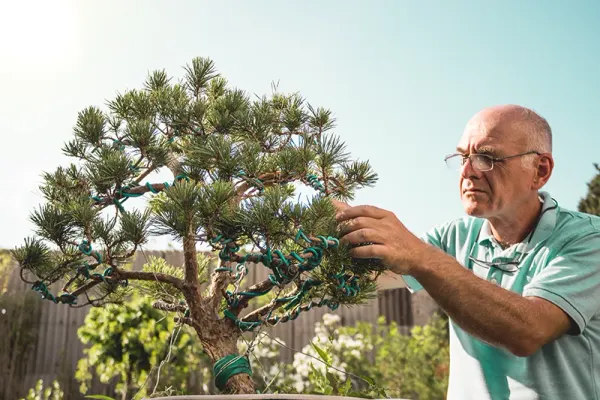
Wire is used to shape the trunk and branches. For styling bonsai, people use wire made specifically for bonsai work. If you don’t have this kind of wire, you can perfectly well use the copper or aluminum wire used for electrical wiring. That wire is covered in insulation, and it will be easier to work with if you strip the insulation off. Branches of different thicknesses need wire of matching thickness, so stock up on wire in a range of diameters.
Cut paste
To keep pests and fungal diseases out, the cut surface left by removing a thick branch must always be covered with a special cut paste. If you can’t buy cut paste, you can make it at home: 1 part rosin, 1 part animal belly fat and 1 part beeswax. Boil all three ingredients together over low heat (15 minutes). Once it cools, the mixture becomes sticky and firm, like stiff modeling clay. When you use it, warm it over a flame until it melts and apply it to the cut with a small brush.
Mesh
Metal or plastic mesh is used to stop soil from washing out through the pot’s drainage hole. The drainage hole is covered with this mesh, and only then is the pot filled with soil. Metal mesh should be copper or stainless steel; ordinary steel mesh soon rusts and falls apart.