Bonsai care (barberry)
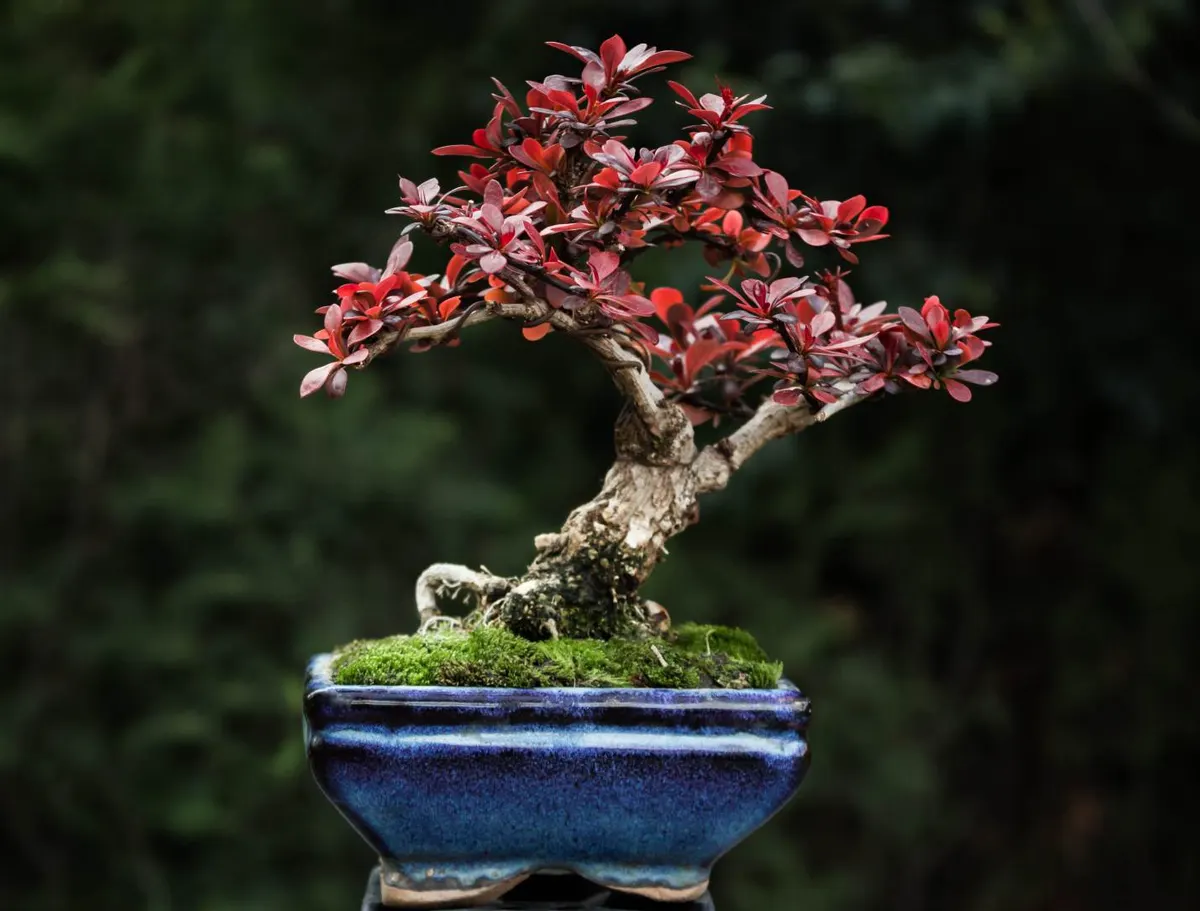
Location
Barberry is not a houseplant, so it should spend most of the year outdoors. It is a light-loving plant. Place it in a bright spot, and in summer keep it out of the scorching midday sun.
From June through August you can keep it indoors, in a well-lit place. From September, though, be sure to move it back outside.
Watering
A bonsai needs regular, careful watering.
In nature, a tree’s roots grow deep into the ground. If it happens that no rain falls for some time, the plant can still get the water and nutrients it needs thanks to its deep roots.
Confined to a pot, a bonsai has no way to direct its root growth wherever it needs to. There is very little soil in the pot, so a bonsai depends on watering far more than a tree growing in nature.
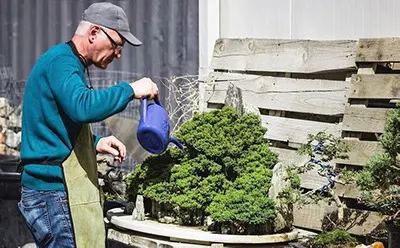
It is also worth noting that on hot summer days the movement of water through the plant, and its subsequent evaporation from the leaves, regulates the plant’s temperature and protects it from overheating. As long as the soil is moist, a plant can keep developing normally even in very high temperatures. When water runs short, however, “scorch” spots appear on the leaves and shoots, which in the end causes the plant to dry out and die.
How much and how often to water
How often a bonsai needs watering depends on the conditions around it, the soil in the pot and the species itself. A bonsai should be watered not on a strict schedule but according to need. In late spring and summer, for example, watering once a day may not be enough. There is another common misconception: that watering while direct sunlight is falling on the plant harms it. In summer it is sometimes actually essential to water a bonsai during the sunny part of the day. So don’t draw up a schedule along the lines of: “The bonsai must be watered once a day, in the evening.”
Some species need soil that stays constantly moist, others need less moisture, but letting the soil dry out completely for a day or two very often kills the plant. Be sure to check the state of the soil every day and water when it becomes necessary.
There are a few simple signs that tell you the soil is drying out: as the soil begins to dry, its surface changes color; the surface of dry soil is relatively hard; and if your bonsai has been in its pot for a few months, you can tell whether it needs water simply by lifting it. The difference in weight is quite noticeable — dry soil is considerably lighter. On deciduous trees, the first sign of late watering is drooping leaves and fresh shoots. For watering bonsai, people use a special small watering can that lets the water flow out gently. Pouring a large amount of water all at once washes away the soil surface and leaves hollows here and there.
Use ordinary tap water for watering. The drawback of such water is its chlorine and high salt content. After regular watering with it, the surface roots and the rim of the pot become covered with a white crust. You will need to remove this crust from time to time.
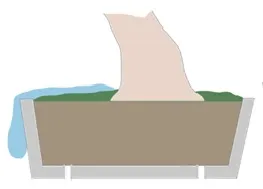
Make sure that after watering, water comes out of the drainage holes; otherwise only the surface may get wet while the soil deeper down stays dry. It often happens that a bonsai is planted in its pot in such a way that much of the water poured on runs off the surface and over the edge of the pot. In that case, pour the water slowly, only as much as will not run off the surface, wait until it soaks into the soil and add more, until you are sure the soil in the pot is thoroughly wet. The sign of well-moistened soil is water running out of the drainage hole.
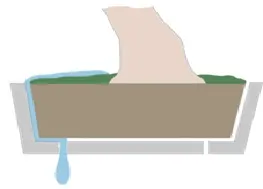
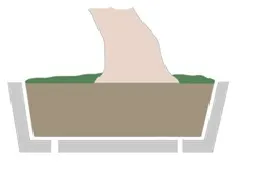
Suppose the soil in the pot has dried out completely. If you look closely at the pot in this situation, you will see that a gap has formed between the pot and the soil. If we water it in this state, most of the water will run through the gap and straight out of the drainage hole.
In that case it is better to set the plant in its pot inside a larger vessel, fill it with water up to the rim of the pot, and take it out once the soil surface is wet. The excess water will drain out through the drainage holes. In spring and summer a plant needs more water than in late autumn or winter. In winter it may turn out that you water the plant only once a month for the whole season (do not water a bonsai during frosts).
It also matters what time of day you water your bonsai. In late spring and summer, when temperatures are high, try to water so that the soil in the pot stays moist through the night. Water in the evening, after sunset. If you water only in the morning or at midday, the soil soon dries out and the plant spends practically the whole night in dry soil. In autumn, when the sun is no longer so fierce, you can water your bonsai at any time of day, preferably in the morning.
As for overwatering: when the soil around the roots is constantly wet, the amount of oxygen in the soil drops. This then causes the fine roots to deteriorate. Damaged roots begin to rot, and if the process isn’t stopped, a large part of the root system gradually rots away. As a result, the tree first weakens and, if the situation is not corrected, dies. So after you have watered your bonsai well, let the soil dry out gradually, and only then water it again.
Prolonged rain can also leave the soil in the pot too wet. But even a week of continuous rain will not harm the plant. The danger is when the soil in the pot stays waterlogged all the time, throughout the whole season.
Bonsai care in winter
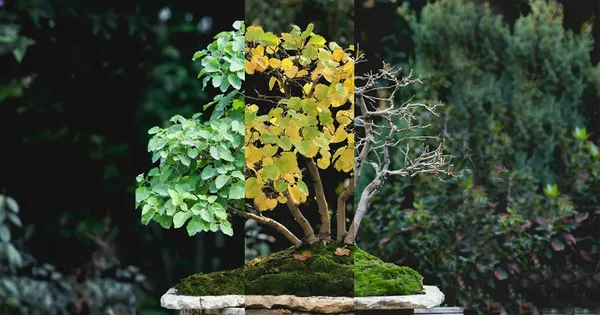
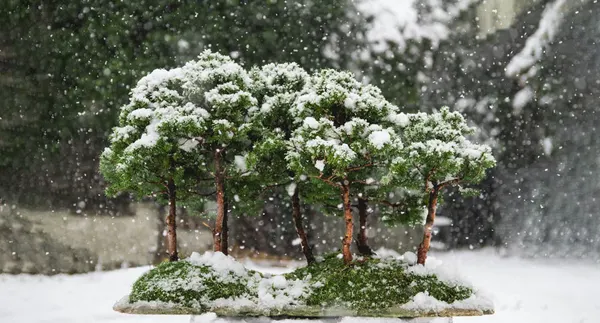
In winter trees are dormant, and their active growth is suspended until spring. The dormant period is just as essential to a plant’s vitality as the period of active growth. That is why bringing a bonsai into the warmth in winter just because it “might catch cold” is fatal for the plant. Of course, bringing it into a room for a day or two to decorate the interior will do no harm. But if it spends the whole winter in the warmth, it will certainly die.
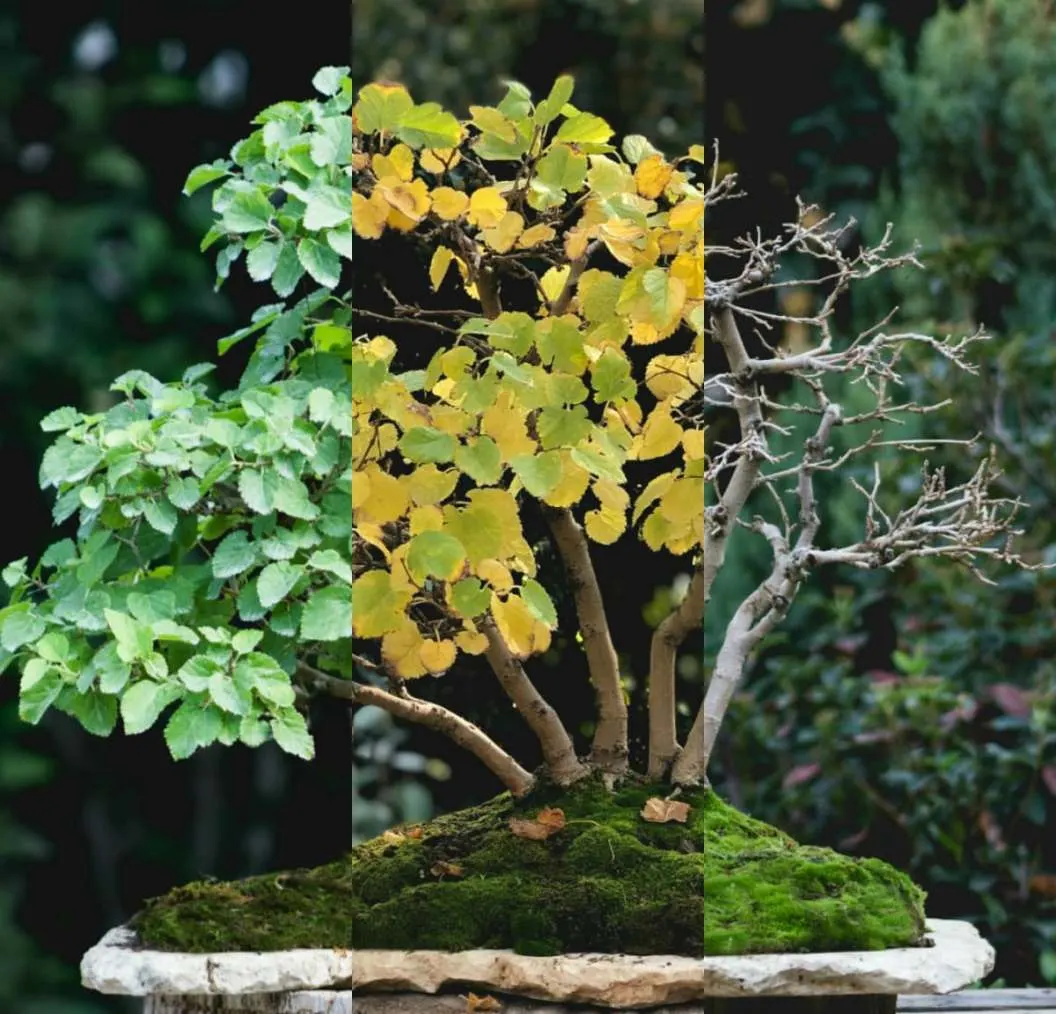
In temperate regions where winters are not very harsh, a bonsai needs no special conditions for overwintering. But in regions where winter temperatures are regularly low (-5°C and below), the plant must be protected from frost. This applies above all to the roots. Bonsai roots are not buried deep in the ground, so they can easily freeze. In Tbilisi’s climate the risk of freezing is lower. But if hard frosts persist for a long time, take a vessel much larger than the pot and bury the plant, pot and all, in sand or sawdust. Under these conditions the roots are relatively well protected from frost.
Protecting bonsai in summer
At temperatures above 30°C, unless we take special measures to protect a bonsai, the plant may be damaged or even die. How well a plant withstands abnormally high heat depends on its own heat tolerance and on how many hours a day the high temperatures last.
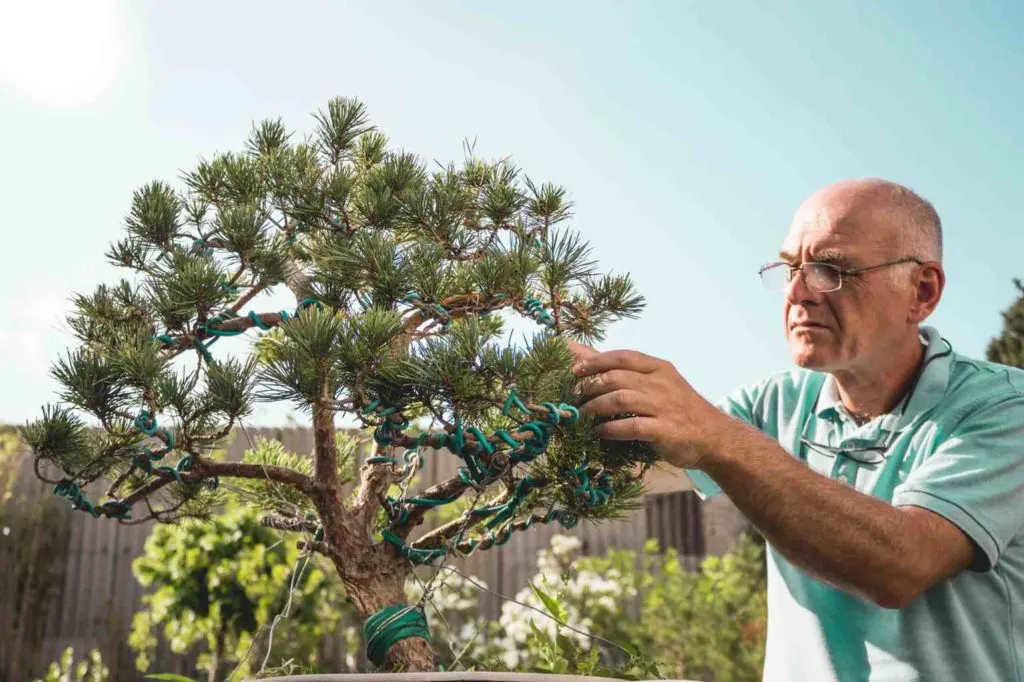
On a deciduous tree the effect of heat is easy to spot. A plant cools itself through its leaves, by evaporating water. At high temperatures it loses moisture quickly. When a bonsai gets too little water in the heat, leaf temperature can reach a critical level. Wilting leaves are the first symptom of water shortage. In severe heat a plant may go dormant prematurely (as it does in autumn). The leaves change color and drop — first the inner and lower leaves of the canopy, then the rest. When direct sunlight falls on a bonsai, the soil in the pot also heats up considerably. High temperatures can damage the roots as well. Under such conditions the plant becomes less resistant to diseases and pests. On a conifer, however, these processes are hard to notice, because its needles don’t give such a ‘signal’. That is exactly why conifers need special attention in summer.
A plant can cope with very high temperatures quite well if you give it normal conditions to function. There are a few simple ways to protect a bonsai from extreme heat. Keep it out of direct midday sun, or rig up some shade for it. Don’t place a bonsai on a surface that gets very hot in the sun: stone, concrete, metal. Try to raise the humidity around the bonsai: mist it more often and water the area around it. Make sure the soil in the pot never dries out completely. Watering at midday is another way to cool the roots.
Fertilizer
For normal growth and development, besides carbon (C), hydrogen (H) and oxygen (O), which a plant takes from air and water, a plant must get macro- and micronutrients from the soil. The macronutrients are nitrogen (N), phosphorus (P), potassium (K), calcium (Ca) and magnesium (Mg). Various micronutrients are also needed in very small doses: iron (Fe), copper (Cu), zinc (Zn), molybdenum (Mo), boron (B), manganese (Mn), sodium (Na) and other elements. All of these elements are vital to a plant’s existence, the macronutrients above all. An excess or deficiency of any of them has a noticeable effect on the plant’s development. For example: nitrogen is needed to regulate growth, for the leaves and for fruiting. A nitrogen deficiency soon shows itself as slowed growth, while an excess prolongs the growth of new shoots. Nitrogen-rich fertilizer is not applied in the second half of the growing season. Phosphorus promotes the plant’s development and root growth, and strengthens its tolerance of drought and frost. Potassium makes the plant resistant to stress (very high or low temperatures, too much or too little moisture). The right amount of potassium improves the buds’ ability to overwinter and the plant’s resistance to fungal and bacterial diseases. Calcium is essential for normal metabolism in the plant. Because there is so little soil in the pot, its nutrients are soon used up. So regularly applying a fertilizer that contains all these elements is just as essential as watering. Without extra feeding the plant develops poorly, its leaves and needles lose their color, and it falls prey to disease more easily.
For bonsai you can use either organic or mineral fertilizer, but you must not mix them together and apply them that way. There is fertilizer made specially for bonsai that contains all the necessary elements. It can be liquid or solid, in granules. Liquid fertilizer is dissolved in water at a set dose, and the plant is simply watered with the resulting solution. Plants absorb liquid fertilizer fairly quickly, so on conifers it is applied once every 3 weeks. Granular fertilizer acts over a longer period. It is either mixed into the soil or placed on the soil surface in special small baskets. With each watering a certain amount dissolves and gradually feeds the bonsai. You can order special bonsai fertilizer online.
If you can’t find such fertilizer, you can use a compound fertilizer sold in garden centers or flower shops. As a rule, these fertilizers contain all the elements plants need. For bonsai it is best to use one that dissolves well in water, as it is more convenient to use. The packaging always lists the composition in percentages (NPK) and how much water to dissolve it in. Be very careful when fertilizing and work out the correct dose precisely, because too much can kill the plant. Ideally it should be NPK 10-10-10 and contain micronutrients.
Feeding usually starts in early spring and ends in autumn. There is no need to fertilize in winter. Never fertilize a freshly repotted plant. Fertilizing is only permissible 4–5 weeks after the start of growth, once the bonsai has rooted well
You can buy “Kristalon 20-20-20” fertilizer at Samto Kimia. Dissolve 2 grams in 1.5 liters of water
Misting
Misting is essential for both deciduous trees and conifers. Start misting when the warm weather arrives in spring and continue until leaf fall begins. In summer it is best to mist every day, although of course in rainy weather there is no need at all. Mist the bonsai when you water it.
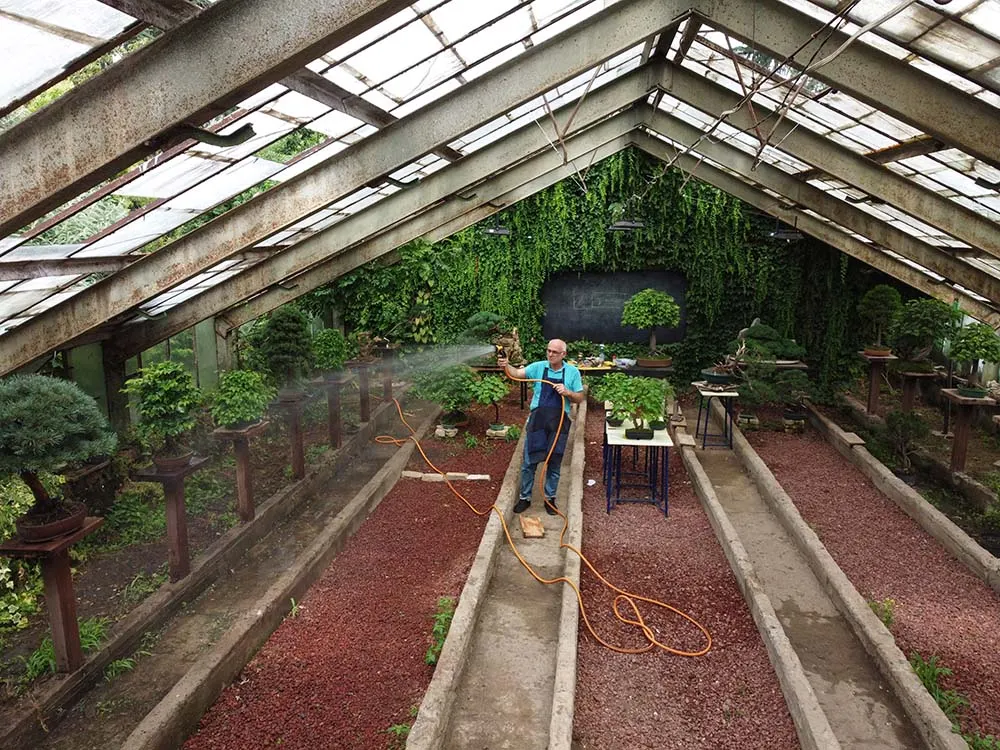
Some water-soluble fertilizers are also intended for spraying on the leaves. This encourages lush, healthy foliage, and the leaves don’t fall ill so easily. There are also water-soluble foliar feeds that give quite a good effect when sprayed. If it is needed, spray with dissolved fertilizer or foliar feed once a week, or as often as you apply fertilizer to the soil.
Diseases and pests
Like any plant, a bonsai can get diseases and be attacked by pests. So it is best to spray preventively once a month from spring to autumn. Ridomil Gold, Strobi Star and Actellic — dissolve all three products together in water at the required dose and spray. Never spray a bonsai in an enclosed space.